In 1965, Harris County voters approved the formation of the Harris County Hospital District, now known as Harris Health. It is the largest of seven tax-supported, safety-net hospital systems in Texas that historically served as “transferring hospitals” under the state’s Medicaid financing programs. Recent state reports indicate that Harris Health provides more than $1 billion in uncompensated and charity care annually.
After years of struggling to break even, Harris Health’s financial position improved sharply beginning in FY2020 and strengthened dramatically during the pandemic. From FY2014 through FY2019, Harris Health reported deficits in three of six years. During the six full fiscal years from FY2020 through FY2025, however, it reported an average annual surplus of approximately $219 million.1
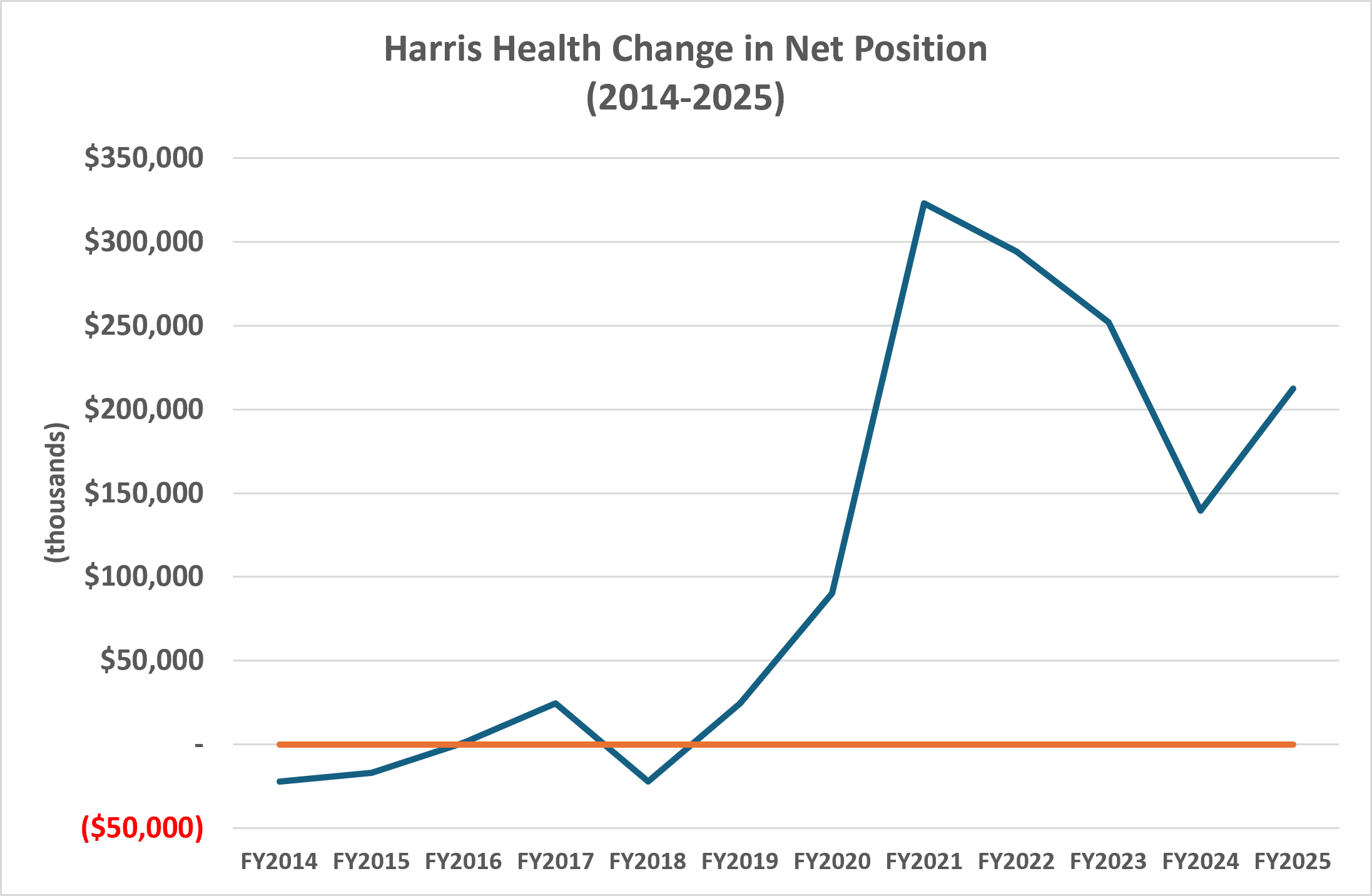
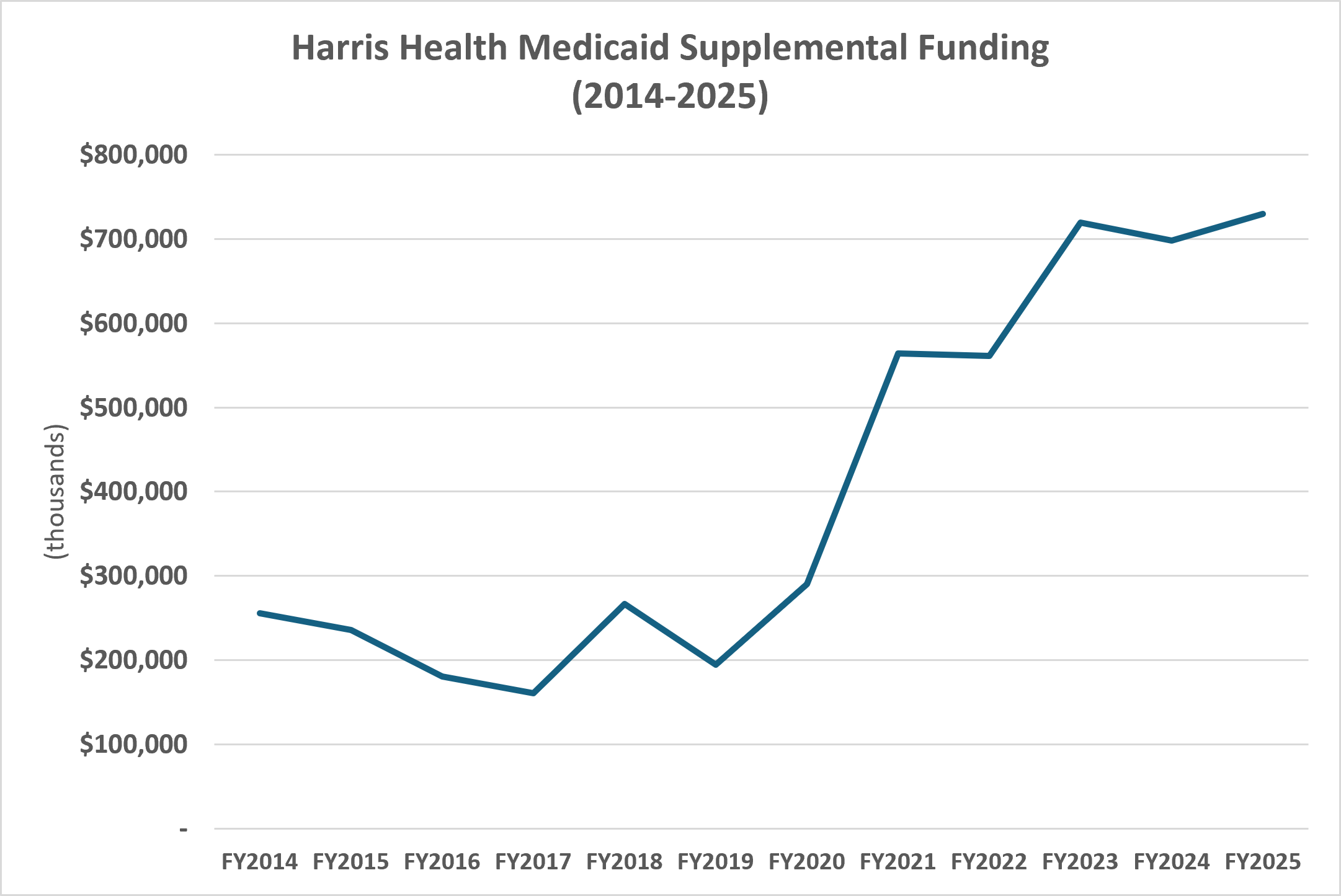
The principal driver of the improved financial results has been a dramatic increase in Medicaid Supplemental Program Revenue received by Harris Health.2 In 2020, the payments jumped by $100 million ($195 million→$291 million), allowing Harris Health to earn an unprecedented surplus of $90 million. But that was just the beginning. Since 2021, Harris Health has averaged receiving $654 million in Medicaid Supplemental payments. Much of the increased funding after 2021 was associated with COVID. However, funding remained much higher even after the pandemic passed. Through the first ten months of this fiscal year, it is on pace to receive a similar amount this year.
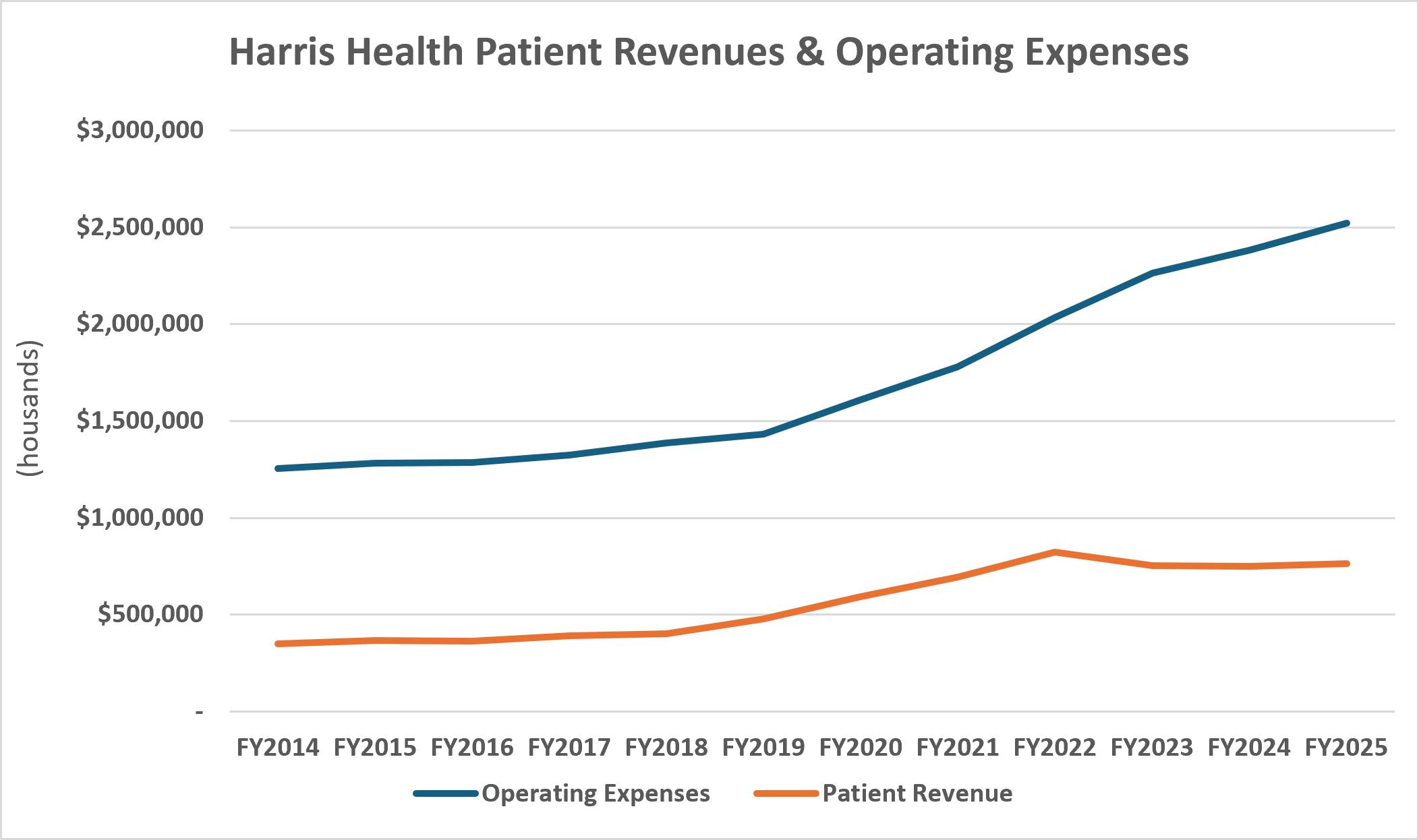
Over the same period, Harris Health’s net patient service revenue—including payments by patients and private and governmental insurers—more than doubled, from $348 million to $762 million. The uninsured share of its patient care fell substantially, from 64% to 43%, likely contributing to this increase.
However, over the same period, its operating expenses were also slightly more than doubled ($1.256 billion→$2.52 billion). Operating expenses have increased by 6.6% annually. While this is obviously much higher than the general inflation, it is generally in line with the cost increases seen by other hospitals.
Over the same period, Harris County taxpayers’ support for Harris Health also roughly doubled, from approximately $516 million to just over $1 billion, a compound annual increase of approximately 6.4%.
As a result of these factors, Harris Health has been able to greatly improve the condition of its balance sheet. Since 2014, its net position has more than doubled and its liquidity (cash + short-term investments) has increased by an astonishing eightfold.
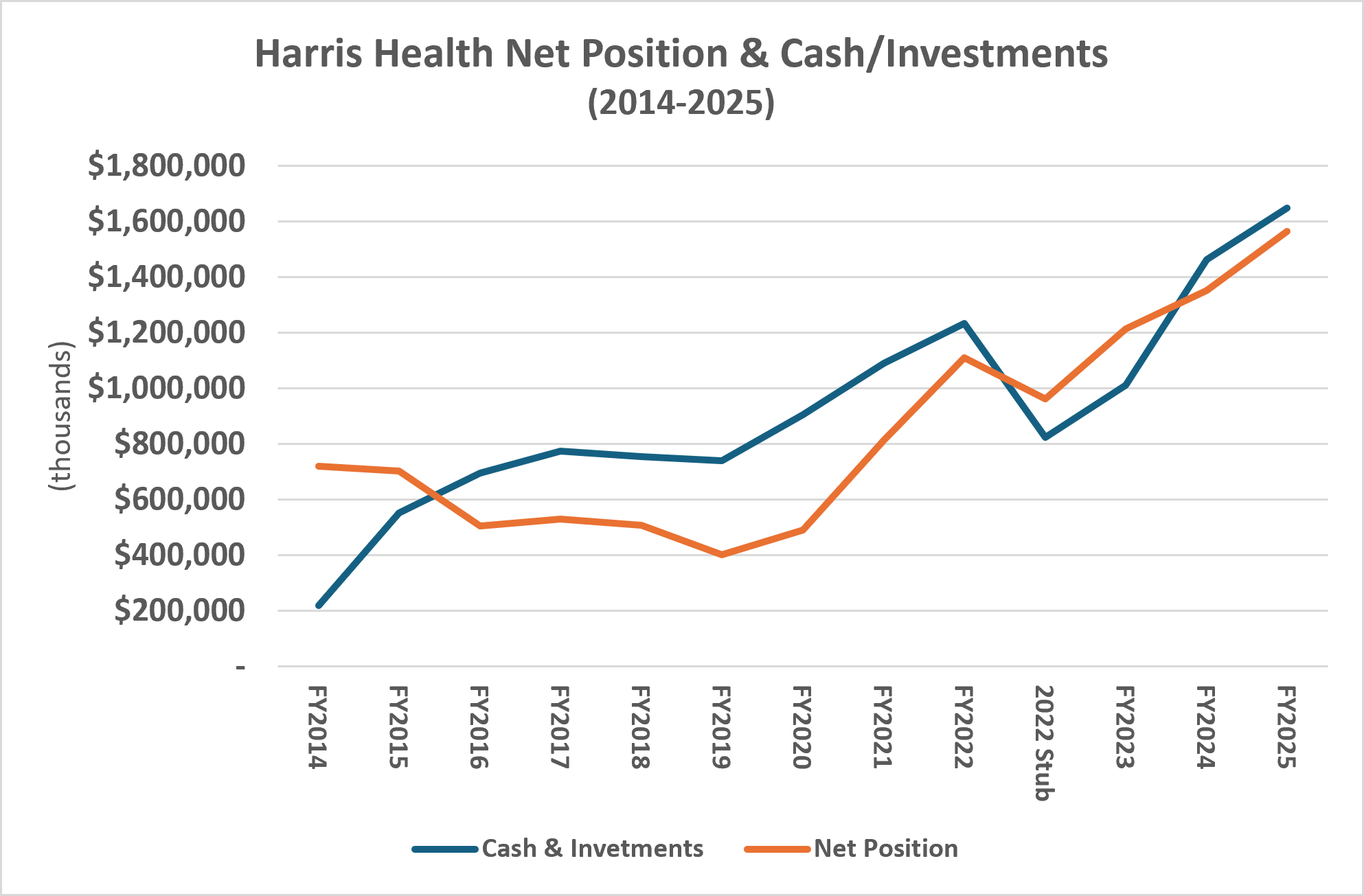
Through the first ten months of the current fiscal year, Harris Health’s monthly, unaudited financial statements show it earned a surplus of approximately $263 million and, as of the end of July, it had just under $2 billion in unrestricted cash and short-term investments.
Despite its strong financial position, Harris Health’s leadership has identified several significant funding risks. These include the scheduled resizing of Texas’ uncompensated-care pool, declining insurance coverage following the expiration of enhanced ACA premium tax credits, new limits on federal Medicaid matching funds for certain noncitizens, changes to state-directed Medicaid payments, and potential changes affecting drug reimbursements.3 During its FY2027 budget presentation to Commissioners Court, Harris Health officials estimated these developments could eventually reduce annual funding by $200 million to $260 million.
However, that estimate is a planning scenario rather than a fixed or announced cut. The ultimate amount will depend on federal-state negotiations, final program calculations, and possible replacement funding. Harris Health expects the largest exposure in FY2028 and later. In FY2027, for example, it is actually projecting a $36 million increase in its Medicaid Supplement payments. So, while concerns about future funding are not unreasonable, the magnitude and timing of any potential reductions remain highly uncertain at this time. If imposed immediately and if all other revenues and expenses remained unchanged, a $200 million to $260 million annual reduction would roughly eliminate Harris Health’s recent annual surpluses. Given its substantial liquidity, however, such a reduction would not create an immediate financial crisis.
Surprisingly, Harris Health has reported relatively flat patient volumes over the last decade. In fact, in several service lines, volumes have declined. However, the pandemic created substantial distortions in the volume data because many noncritical services were suspended and patients frequently avoided hospitals, sometimes even when they needed care. So, the long-term trends are a bit muddled. (More on this soon.)
In their budget presentation to Commissioners Court, Harris Health leadership blamed flat patient volumes in recent years on capacity constraints. Part of their pitch for additional funding was to continue to build additional capacity. In 2023, voters approved a $2.5 billion bond program, primarily dedicated to rebuilding LBJ Hospital, to at least partially address capacity constraints.
While capacity constraints are undoubtedly part of the surprising lack of growth in patient volumes, I suspect underlying demographic factors are also at work, e.g., the decline in births and a decline in the undocumented population. I would caution against being too aggressive in adding capacity, especially investments with long payback unless they are supported by realistic, service-specific demand projections.
______________________________________
Note 1: All Harris County related entities, including Harris Health, changed their fiscal year in 2022 from ending on February 28 to ending on September 30. This change created a “stub year” for March-September 2022. This analysis omits the stub year for consistency.
Note 2: Medicaid Supplemental Programs Revenue does not include ordinary Medicaid claims payments, which Harris Health reports as Net Patient Service Revenue. It consists of other supplemental payments intended principally to support safety-net providers and offset payment shortfalls and uncompensated care costs.
Note 3: There have been numerous erroneous media reports that Texas hospitals are already losing “$27 million per day” in federal funding. That reporting was based on the Trump Administration withholding about $9 billion of funding from Texas based on certain potential compliance issues. Governor Abbott has maintained that Texas is in compliance with the terms of that funding, and hospital administrators I have talked to expect the issues to be resolved and that Texas will receive the funding.