Texans showed up in record numbers to vote early for a midterm election. The latest numbers from Theo Elections show that nearly 6.9 million Texans voted early this year, compared to about 5.5 million in the 2022 midterm (+25%). This, however, is still well below the 9.1 million who voted early in 2024.
Of those who voted early, 2.1 million had voted in a Republican primary in the last six years, compared to just over 2 million with a Democratic primary voting record, giving Republicans about a 90,000 edge with primary voters. Over 2.7 million who voted had no recent primary voting history or had recently voted in both primaries (39.5%). This is a startling departure from the early vote results in 2022 and 2024. In those elections, Republicans had a primary history advantage of over 600,000.
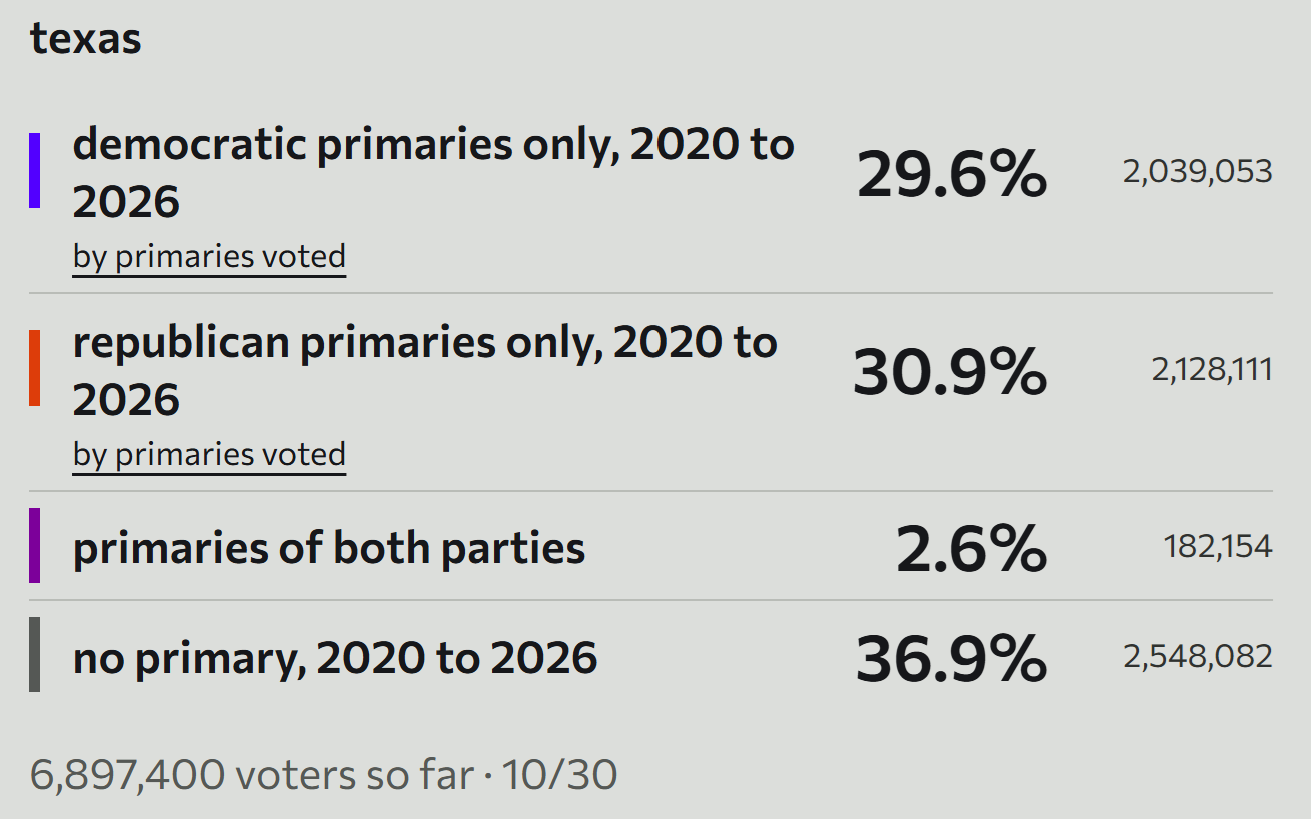
So, here are the questions that will determine the outcome of the election:
How did the 2.7 million voters with no or mixed primary history vote?
In 2022 and 2024, these voters broke fairly evenly, except for Trump in 2024, who won them by 56%. If that pattern repeated this year, the parties came out of the early voting in a virtual tie.
However, most of the polling has shown independents and Latinos breaking against Republican candidates. Those groups likely make up a large portion of the mixed early voters. If that is the case, that would be more than enough to wipe out the relatively small advantage Republicans had with primary voters, and Republicans are going into Election Day with a deficit. Paxton’s deficit is likely quite a bit larger than the other Republican statewide candidates because he is doing worse with independents and there is a contingent of Republican voters who continue to say they are not going to vote for him.
What will happen on Election Day?
If the 2022 midterm pattern holds, about 3 million more Texans will vote on Election Day. In recent elections, Republicans have done well on Election Day. In 2024, Trump beat Harris by 350,000 on Election Day, and in 2022, Abbott bested O’Rourke by over 400,000 votes. If that pattern holds, it would probably be enough for all of the statewide Republican candidates to win, apart from Paxton.
There are a few reasons to believe that is a reasonable possibility. First, there are about 470,000 more voters with Republican primary histories than Democratic ones who have not voted. That is, Republicans will have a larger pool of partisan voters to potentially get to the polls on Election Day. There are almost 250,000 voters who have voted in 3 or 4 Republican primaries but have not yet voted, compared to only 90,000 Democrats.
Second, the unaffiliated pool may be somewhat more Republican leaning than in previous elections because Democratic primary turnout increased by more than one million voters this year. That surge effectively moved many previously unaffiliated voters into the Democratic-primary-history category.
Third, the Election Day weather forecast is poor, with a major front expected to move across the state. Historically, bad weather has tended to suppress Democratic turnout somewhat more than Republican turnout, although it is unclear whether that pattern still holds today.
But there are some other unanswered questions. For example, rural voters underperformed during early voting. They normally break 80-20 for Republicans. Does their apparent lack of interest during early voting indicate a shift in their pro-Republican sentiment?
Another big question is how mad independents and Latinos are at the Republicans. The crosstabs in the polls vary widely from one poll to another. If the results are as bad as some polls indicate, nothing else is going to matter.
And the big question for Paxton is how many Republicans are going to defect and vote for Talarico or simply skip that race. The polling suggests it is about 10% of Republicans. If that holds, it is hard to see how Paxton can win based on the early vote results.
There are so many variables and unknowns in this race that a wide range of outcomes are possible, including a potential sweep for either party.
Tuesday night should be quite interesting and unlike anything we have seen in Texas elections for over 30 years.
Note 1: Theo Elections uses individual voter rosters to determine previous primary-election participation when that data is available. When it is unavailable or delayed, the site uses estimates based on previous precinct-level turnout. The site updates its estimates as voter-roster data becomes available.