As Harris County prepares to adopt its budget for the upcoming fiscal year, our team at the Baker Institute conducted a comprehensive review of the County’s current budget and budgeting process. You can review our report here. We concluded that Harris County enjoys a relatively strong financial position; however, it is likely to face significant fiscal headwinds in the future.1
Here are the highlights:
- Harris County is very dependent on property tax revenues. Property taxes make up over 80% of its general fund revenues.
- Prior to last year's budget cycle, the County Budget Office highlighted that over the last five years, the County’s expenditures have been growing faster than its revenues (7% vs. 5%), and that the County will run significant deficits over the next five years unless the County raises more revenues or trims spending.
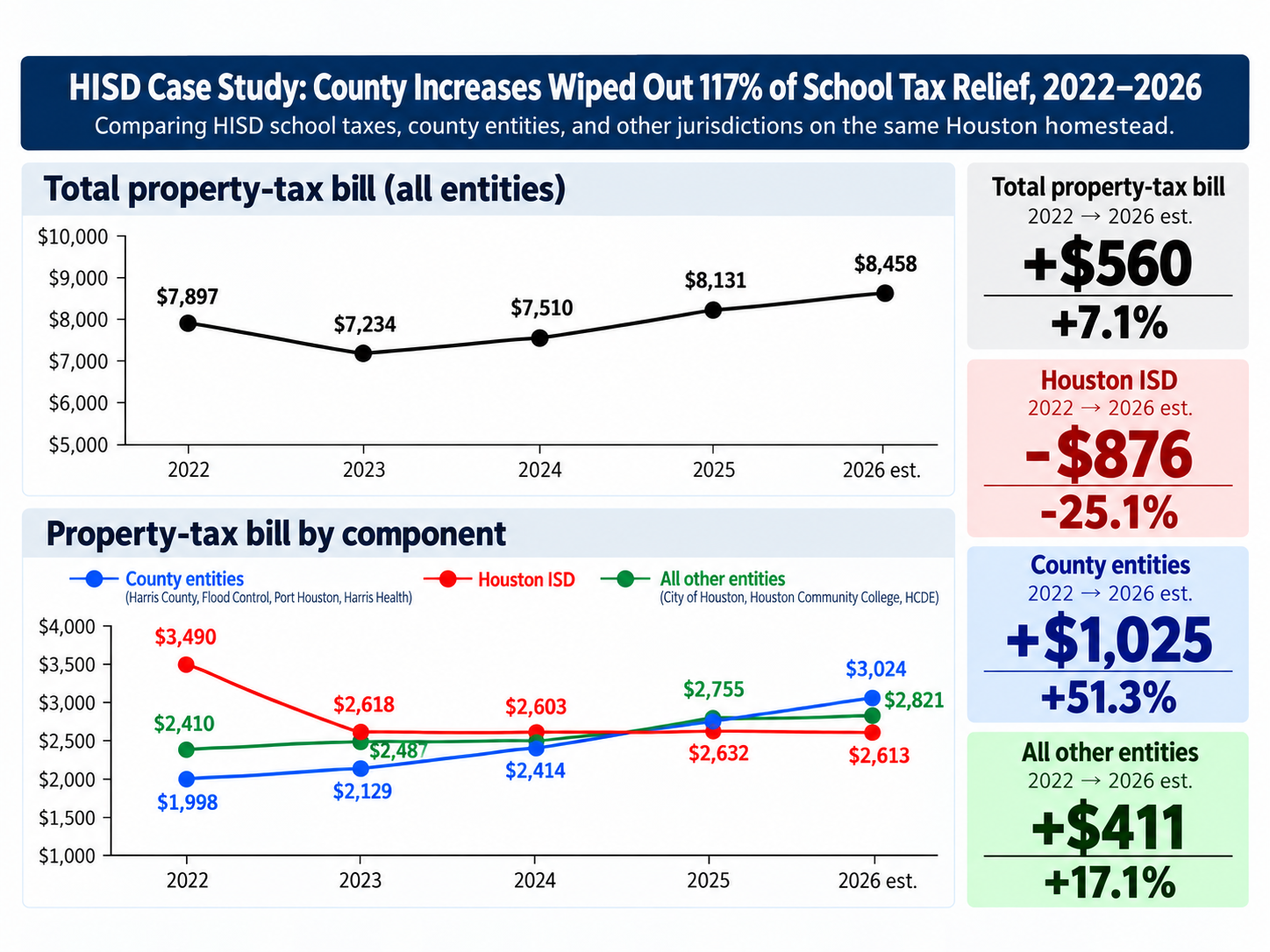
- From 2020 through 2023, the County’s property-tax revenue was relatively flat. However, the County dramatically increased its property-tax rate by approximately 10% in 2024, resulting in record property tax collections. The County Budget Office is assuming the property tax base will increase by 5.5% annually in the future. However, due to state-imposed limitations, political constraints, and other market and demographic factors, we are skeptical that the County’s tax base will grow at that rate.

- The County’s general fund expenditures are dominated by law enforcement (46%) and the administration of justice, i.e., the court system (17%). Because of recent substantial pay raises for law enforcement officers, those percentages will likely increase in future years. The overcrowding of the Harris County jail due to the backlog of cases in the Harris County courts continues to be a financial challenge for the County. However, there has been some improvement in reducing the backlog in the last year.
- The County is very dependent on excess revenues from the Harris County Toll Road system to fund county road projects. However, as we have previously noted, the County may be approaching the limit on how much it can transfer from the toll road system, which will put additional pressure on its General Fund.
- During and immediately after the pandemic, the County relied very heavily on federal grants related to the pandemic. Several new programs were launched, and headcounts in several departments were increased. Most of those grant funds have now been expended, and the County will face difficult decisions about finding alternative funding or scaling back or eliminating those programs.
- From 2018-2023, the County’s headcount increased marginally (17,363 →17,969). However, due in part to federal grant funding, the headcount increased by 11.4% over the last two years (17,969→20,020). This increase in the headcount has significantly contributed to expenditures growing faster than revenues.

- Harris County’s finances are extremely complex. The County Budget Office must assemble and reconcile information from dozens of departments. We found its staff competent, cooperative, and transparent in its dealings with us. Nevertheless, the County could make significant improvements to its budget documents and website, making its finances more transparent and accessible to ordinary residents.
- This was our original baseline review of the County's finances. We will be following up on this in the future.
___________________________________
Note 1 – Our review was limited to Harris County’s General Fund. In addition, the County is responsible for the Harris County Toll Road Authority, Harris Health (formerly the Harris County Hospital District), and the Harris County Flood Control District. Our report only addresses those entities to the extent they directly impact the General Fund.