All or some portion of 25 school districts lie within Harris County. According to data released by the Texas Education Agency earlier this year, 18 of those districts saw their enrollment decline last year, losing a total of 26,535 students – about a 3% decline. Total enrollment fell to 890,199. It is the first time since the 2013-2014 school year that their combined enrollment has been below 900,000.
It is hardly surprising that Houston ISD contributed the largest part of the decline, losing 7,915. However, you may find it surprising that three districts (Aldine, Alief, and Pasadena) are losing more students than HISD on a percentage basis. This is a link to a pivot table that will allow you to look at all the data on the Harris County school districts.
There is a clear geographic pattern in Houston-area school enrollment. Districts closer to the urban core have generally been losing students, while enrollment growth has increasingly been concentrated in districts on the metropolitan fringe.
Not all of the decline can be attributed to demographic changes alone. When we looked at the enrollment declines at HISD at Baker last year, we estimated that about half the decline was due to overall population loss and about half to parents opting for other alternatives, primarily charter schools.
Public schools are in the midst of a confluence of factors which will likely continue to put pressure on their enrollments. The overarching factor in the background will be the declining birth rate. Below is the current population pyramid for the state of Texas. I have added lines for the youngest cohorts to highlight this trend. This means that without very substantial immigration, Texas will never have more school children than it has today. When added to the growing array of alternatives, the prospects for public school enrollment are quite bleak.
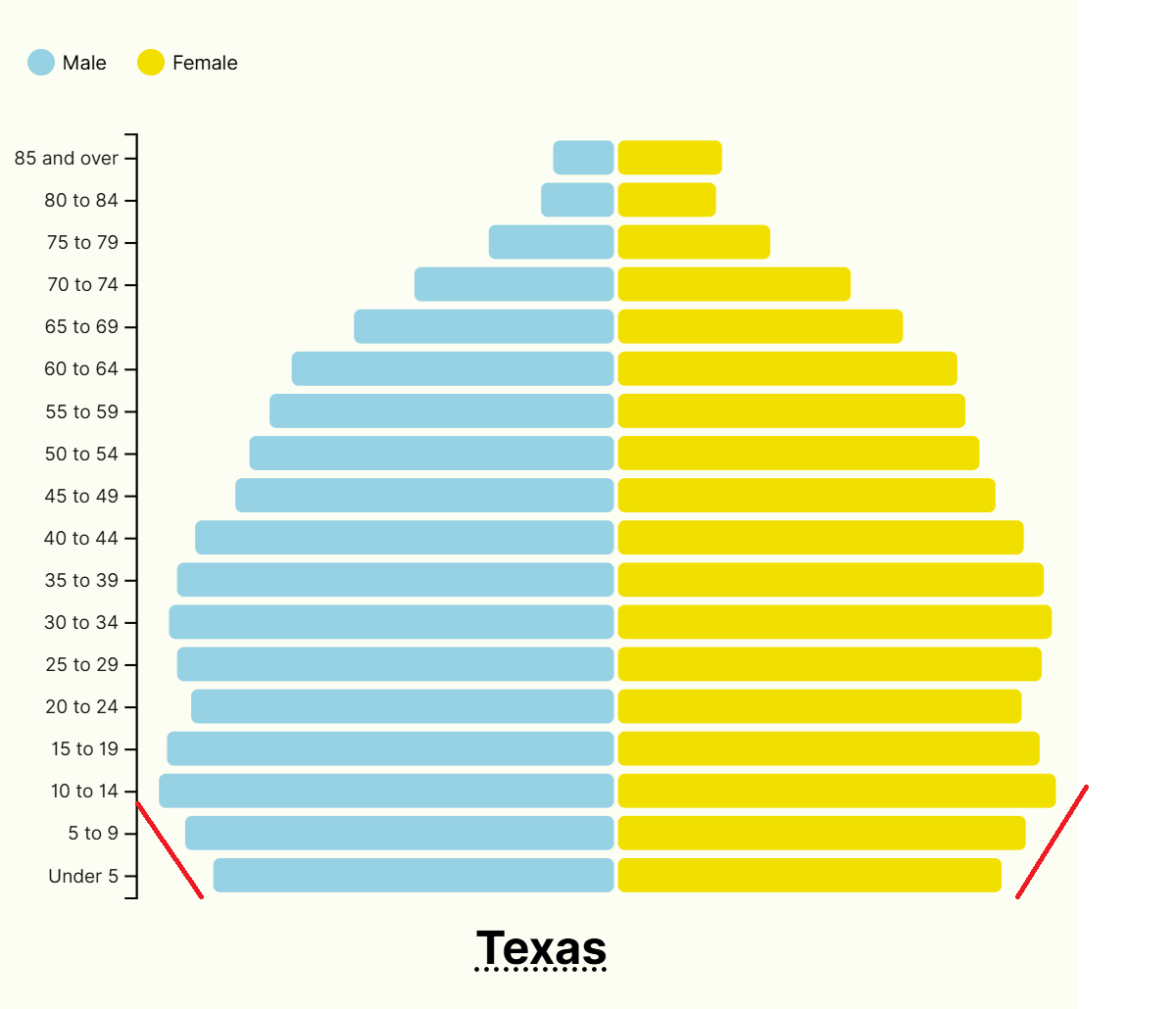
Nonetheless, there will still be some districts that will grow. For example, Lamar Consolidated School District, on the far southwestern edge of our region, grew by nearly 25% in the last five years and over 4% last year. But, ultimately, the declining birth rates will catch up with everyone because, like Mother Nature, demographics bat last.